
What Does It Mean to Eat Well?
Eating well isn't about following another set of rules. It's about understanding food well enough to make intentional choices that support your body, fit your life and leave room for enjoyment.
For most of my life, I thought I knew the answer to that question. Or at least I thought I was supposed to. After all, I went on my first “diet” when I was ten years old.
My grandmother had been given a diet by her cardiologist before surgery, and I decided to follow it too. I remember hot dogs, cottage cheese, saltines, beets—and half a cup of vanilla ice cream. At ten years old, I held on to that dessert with everything I had.
By thirteen, I was attending Weight Watchers meetings and dreading the weekly weigh-in. Over the years, there would be other diets and protocols. Some were highly restrictive. Some produced quick results.
However, knowing how to follow a diet and knowing how to nourish yourself are two very different things. I learned the first long before I learned the second. And somewhere along the way, food became connected not only to rules but to guilt.
When I was thirteen, someone said something to me that I would carry for decades: “Every bite that goes past your lips goes straight to your hips.”
I can hear that statement now and recognize how profoundly it misunderstands the complexity of the human body. Thirteen-year-old me didn't have that knowledge.
She heard something much simpler: Every bite changes your body. So every bite should be feared, evaluated or earned. That's a difficult way to spend a lifetime eating.
When I was fifteen, my mother had a heart attack at the age of forty-four. It was just the two of us in our household, so when she came home from the hospital, I became her caretaker.
I was given fairly simple instructions about food: eliminate sodium and fat from her diet. I was also supposed to help reduce her stress, but I didn't have much control over that one, so I focused on what I could control. I cooked.
I remember that there were a lot of chicken breasts and steamed vegetables. At the time, I was instructed not to cook with oils and to use only lemon and one of the two flavors of Mrs. Dash for seasoning (because that was all that was available). I even taught myself how to grill because it made the food taste better than just baking or steaming. I was fifteen. I was doing the best I could with the information I'd been given.
The reality is that experience reinforced another belief I carried with me: Healthy food is supposed to be bland, and healthy food is what you eat because you are supposed to.
The foods that you actually craved, that were full of flavor and had pleasure attached to them, lived somewhere else. So for years, the pursuit of health often felt like a choice between nourishment and enjoyment.
This perspective on what makes food “good” or “bad” for a person continued into my thirties. Then, while attending massage therapy school, I was required to take a nutrition course. It changed the way I looked at food.
For the first time, my primary question began shifting away from What can I and can't I have? toward What does my body need and deserve?
That distinction may sound small, yet it wasn't. Food stopped being only something I needed to control and became something I wanted to understand. And understanding changes the conversation.
Even today, someone may see me make a choice that supports my health and ask: “Are you on a diet?” Or they'll see me eating something they don't associate with “healthy eating” and ask: “Can you eat that?”
My response is usually some version of: I can eat whatever I choose to.
Of course, that's not literally true for every person or every health condition. Allergies, celiac disease and other medical considerations can create very real boundaries around food.
However, “Can you eat that?” is often the wrong question. More useful questions might be: What does this food provide? What does my body need? How does this choice fit within the larger pattern of how I eat and live?
Those questions are important, and the answers need to be individualized. That requires enough food literacy to understand both what broadly supports human health and how those principles apply to us as individuals. And that brings us back to the question that started this whole conversation.
So What Does It Actually Mean to Eat Well?
This is where I don't want to replace one set of rigid food rules with a vague message that says everyone's different, so anything goes. There are principles of nourishment that broadly support human health. The World Health Organization describes four foundational principles of a healthy diet: adequacy, balance, moderation and diversity.
Broadly, a health-supportive dietary pattern provides sufficient energy and nutrients, includes a variety of nutrient-dense foods, and limits certain dietary components when consumed in excess. Fruits and vegetables, whole grains, legumes and varied protein sources can all contribute important nutrients to that pattern.
Even so, there isn't one single way those principles have to look on every person's plate or show up in everyday life. Our cultures, traditions, health conditions and lived experiences get to be considered too. We are individuals, and what supports us needs to honor that. That isn't a loophole around nutrition science; it's an important part of applying it.
Dietary guidance around the world reflects differences in food availability, nutritional needs, culinary cultures and eating traditions. Different dietary patterns can still share the principles associated with supporting health.
Science gives us the principles and food literacy helps us live them.
That's the middle ground that I am passionate about. What does the evidence say? What should we understand from that evidence, and then how do we apply it to our real lives? Because knowing why a food may support your health and knowing how to make it work in your life are two different skills.
For years, I would order salmon at restaurants but I never prepared it at home. I knew salmon could be part of a health-supportive eating pattern, but knowledge wasn't my problem. I didn't have the confidence to cook it in a way I actually wanted to eat it. However, when someone else who knew what they were doing prepared it, I really enjoyed it. And salmon isn't unique.
You can understand why you might want to eat more vegetables, legumes, whole grains or seafood and still not know how to choose them, prepare them, flavor them, substitute them or incorporate them into foods you already enjoy.
A recommendation can give us direction, but understanding helps us figure out what to do with it. And as we begin putting that understanding into practice, we build the skills and confidence to make those choices for ourselves.
As someone who does quite a bit of research, I know how powerful evidence can be. The reality is that evidence truly becomes useful in everyday life when we understand what it means and how to apply it. If someone can't see how a recommendation could possibly fit into their actual life, it's unlikely to become something they can consistently use.
So what does that understanding look like when I'm standing in my own kitchen? When I'm building a meal, I'm generally looking for nutritional diversity. I start with a meaningful source of protein. Then I decide which fruits and/or vegetables will not only complement the protein but also add complexity of nutrients. Over a period of time I like to incorporate different types of produce to support nutrient diversity.
It wasn’t too long ago that I would have stopped there because I didn’t understand the vital role that carbohydrates play in our bodies and how many systems rely on what they provide. Now I look for carbohydrate sources such as whole grains, fruits, vegetables and legumes that can also contribute fiber, vitamins and minerals.
Despite what 15-year-old me was told back then, I also include health-supportive sources of fat. Because, yes, your body's systems and functions need those too.
And across the larger eating pattern, I'm looking for enough variety to help provide the energy and nutrients the body requires to do an extraordinary amount of work behind the scenes every day. That doesn't mean every meal perfectly checks every box.
A framework or guideline should help you recognize what a meal provides, not determine whether you've passed or failed the meal. This is not another test to pass or a judgment to be received.
And then I consider something else: Does this actually sound good? Because nutritional adequacy matters. We also have to eat the food and hopefully enjoy doing so in the process.
We just talked about how I build my plate, which matters, but I would argue that how I decide what to make is just as important (and some days more important).
When I choose what I want to make, I often start with the flavor or experience we (myself and whoever I am cooking for) are craving.
What sounds really good? Something creamy and savory? Perhaps bright and smoky? Maybe spicy, smoky and crispy? Or simply something that is comforting…there is something so special about a meal that feels like a warm hug when you need it. I am sure that you can think of a meal at this very moment that feels comforting to you, and the chances are that it is completely different from the meal that immediately comes to my mind. And THAT is the difference: food literacy gives you an opportunity to honor your desires, while supporting your health.
Then I look at the dish holistically. Let’s talk about Alfredo, which happens to be one of my favorite “comforting” foods. Rather than deciding Alfredo simply doesn't fit the needs of our household, I look for the meaningful points of friction. What ingredients make the dish not a supportive fit for our household, and what else could I put in their place to perform the same job in that dish?
In my version, I can use blended lactose-free cottage cheese to create the creamy base rather than building the sauce around heavy cream. Then I rebuild the experience from there. Garlic. Acidity. Umami. Parmesan. Herbs and seasonings layered in ways that preserve the flavor I was craving in the first place. After all, I am not trying to remove everything enjoyable from Alfredo until I've created a nutritionally impressive bowl of sadness. I'm addressing the parts that matter for the people eating it while preserving what made us want the food in the first place. And once I've done that? I stop.
The nutrition decisions have already been made, and now I can return to the experience that I want to recreate. The creaminess. The aroma. The texture. The flavor. The satisfaction.
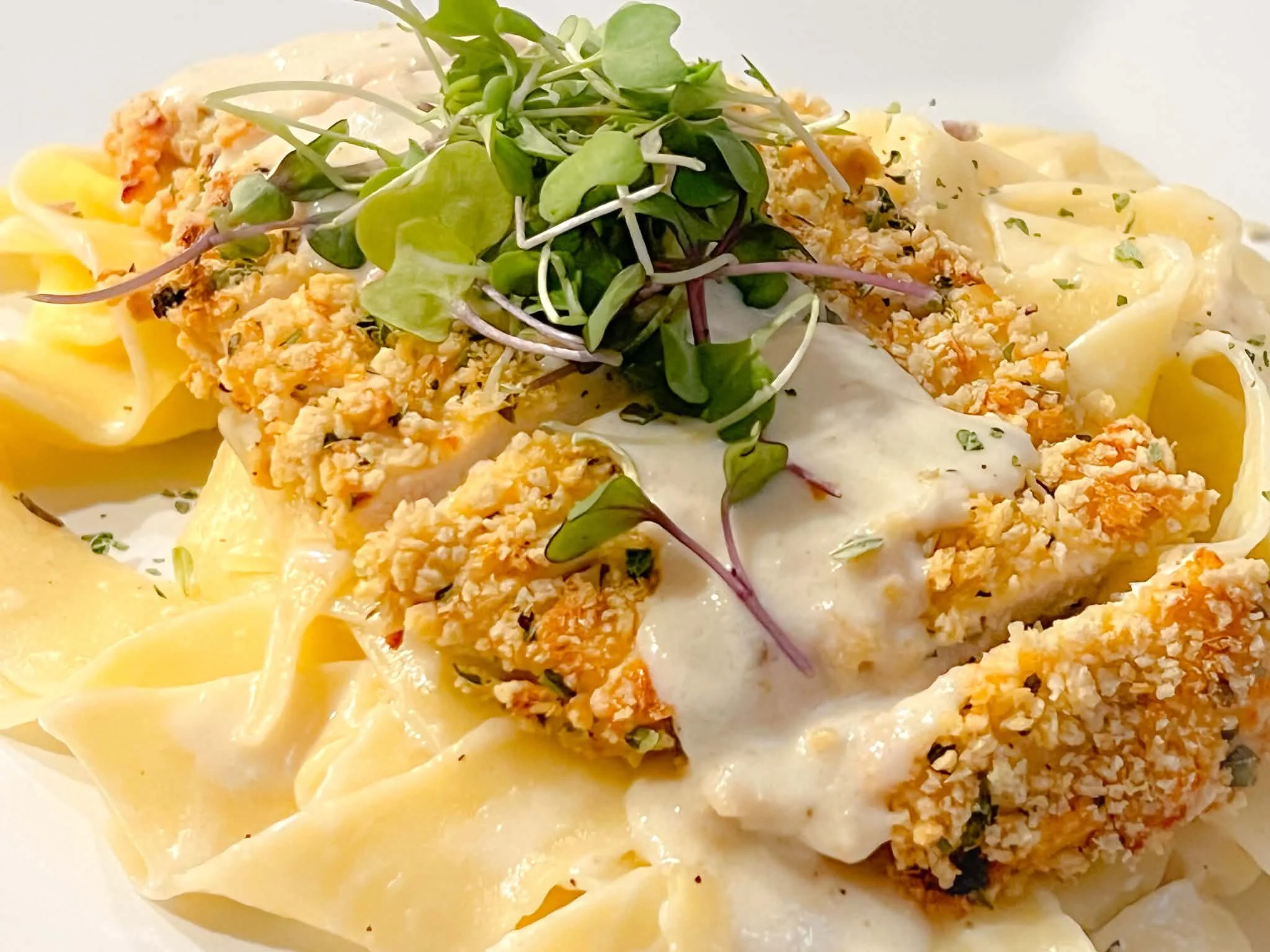
Crispy chicken served over pasta with a creamy Alfredo sauce and fresh microgreens.
First, adapt what needs adapting. Then let the food be food.
I wish I'd understood that when I was fifteen. Because about thirty years after my mother's heart attack, her health once again required changes to the way she ate. This time, I approached the problem differently.
At fifteen, I had started with what needed to be removed. Thirty years later, I started by asking my mother: “What are you craving?” I made her a commitment: I would work on adapting foods she craved in ways that better supported her health needs, and her commitment to me was simply to try them once.
The health considerations were still real. Adaptation doesn't mean medical needs disappear, and some dietary boundaries are genuinely non-negotiable.
Adaptation preserves the intention while allowing the method to change.
Once we know more about what supports our health, there's another temptation to change everything all at once. New groceries. New breakfast. New lunch. New dinner. New exercise routine. Meal prep Sunday. More water. More vegetables. Less sugar. Earlier bedtime. It all starts on “Monday” and by Wednesday we're exhausted. Yes, I have been there too!
However, the best first change isn't necessarily overhauling everything you've decided no longer supports you. It also isn't necessarily starting with the change that would make the biggest impact. Sometimes it starts with a simple yet important question: What is one meaningful change I feel confident I can actually make?
That change doesn't have to be complicated. It could mean adding a fruit or vegetable to a meal that rarely has one, finding a breakfast that better supports what your body needs, or cooking one additional meal at home each week. It might even be as simple as freezing tonight's leftovers before they become next Thursday's science experiment.
The change doesn't need to look impressive; it needs to be something you can practice. Because every time we successfully practice a supportive behavior, we gain experience doing it. And experience can help build confidence.
Then we build from there. Small, supportive changes practiced consistently can become meaningful change over time. You don't have to change everything to begin changing something.
One way I approach that is through something I call Build Before You Remove™. Instead of always beginning with the question What do I need to stop eating? you might ask: What could I add that would better support my body?
Build Before You Remove™ begins by directing attention toward supportive foods and behaviors we can add rather than making restriction the first task. That doesn't mean addition is always superior to restriction. Some foods or dietary components may genuinely need to be limited, and some health conditions require very specific boundaries. It means restriction doesn't always have to be where change begins.
In our house, I'm regularly looking for something we haven't tried before. Often that's an unfamiliar fruit or vegetable at the grocery store or farmers market. Other times it's a grain, legume, spice, ingredient, flavor, recipe or preparation technique. The point isn't novelty for novelty's sake. It's curiosity.
That curiosity expands the ingredients, flavors and techniques we know how to use, while also potentially increasing dietary variety. And it creates more possibilities for building meals we genuinely enjoy.
Over time, additions can also change the overall eating pattern. Some choices may naturally occupy less space because we've built something different around them.
Be so focused on what you're adding to support your body that you barely notice what gets pushed out.
Building a more supportive pattern is only part of the equation. For that pattern to become something you can actually sustain, it has to be able to adapt when life does what life inevitably does… change.
You get exhausted or you travel. Money gets tight or your schedule changes. You're caring for someone. Everyone wants pizza. Or the spinach you bought with excellent intentions is slowly becoming one with the refrigerator drawer.
This is where knowledge alone isn't enough. We need to recognize friction.
If exhaustion means convenience foods continually win, maybe supportive food needs to become more convenient. I often intentionally make more than one meal's worth of food. Instead of putting all the extra in the refrigerator, I can portion some and freeze it immediately.
I'm not asking future exhausted Jennifer to suddenly become more disciplined. I'm reducing friction for her by anticipating that there will be times when she won't have the energy and will want to reach for something convenient.
Anticipating friction can help us build support for the challenges we can see coming. We can't anticipate everything, and sometimes the circumstances themselves change. That's when we need to be willing to adapt the plan rather than assume we've failed because the original plan no longer fits.
Because sustainable wellness has to work within a life that doesn't remain static. Our bodies change. Our schedules, resources and responsibilities change. The environments we're living in change.
And when they do, the question doesn't have to be: How do I force the old plan to keep working? It can become: Given what is true right now, what is still possible?
What Does Moderation Actually Mean?
Moderation is one of those wellness words we hear so often that it can start to sound like it explains itself. Everything in moderation. Okay. What does that actually look like?
For me, it's helpful to think about moderation within the context of the overall pattern.
In my own life, I sometimes think about this as an 80/20 pattern; however, most of the time it isn’t that specific because human nutrition doesn’t follow a mathematical formula and certainly doesn’t require you to count every bite. It's simply a way of reminding myself that the majority of my choices can support what my body needs while leaving room for foods, meals and experiences that may serve other purposes too.
When I'm cooking at home and choosing the ingredients, I generally choose versions that support our household's health needs while still making food we genuinely enjoy. That's the everyday pattern.
Then there is the rest of life. Which consists of restaurants, celebrations, dinner at someone else’s house, vacations and road trips…and yes, the traditional version of a food that I simply want to experience as is.
Those choices don't need guilt, compensation or a promise to “be good tomorrow.” They're part of living.
With that said, moderation also doesn't mean manufacturing an exception every time we want one and calling all of them “special occasions.” There is always an excuse if you look for one, believe me I know.
That's why I find the pattern more useful than keeping score. Don't count the occasions. Notice the pattern. If the overall pattern consistently supports what my body needs, an exception can simply be an exception. If the exceptions are happening often enough that they've become the pattern, that's useful information too.
The exceptions shouldn't quietly become the pattern.
And even this requires individual context. For someone with celiac disease, for example, gluten isn't something to include “in moderation.” A food allergy isn't suspended because it's someone's birthday. Certain health conditions create boundaries that flexibility doesn't override.
That's why moderation can't be reduced to one universal percentage or rule. It shouldn't be treated as an exact formula. It's a principle that can help guide us, but applying that principle requires understanding what it should look like for the individual living it.
And I think the same is true when we try to determine whether the choices we're making are actually supporting our health. We need to understand what we're trying to support—and make sure we're looking in the right places for evidence of change.
Many of us have been conditioned to decide whether nutrition is “working” by looking almost exclusively at the outside of our bodies. Our jeans feel tight. We don't like what we see in the mirror. The scale changes—or doesn't. And those things can become the catalyst for another “diet”. Your body is much more complex than what you can see from the outside.
Someone may intentionally change how they eat because they and their healthcare team are working to support blood glucose, blood pressure, blood lipids, nutrient status or other health considerations.
Then a few weeks later, they step on the scale. Nothing. And suddenly: “This isn't working.”
What were we working on? Don't ask the scale to measure work it wasn't designed to measure. If we're trying to support a particular health outcome, we need an appropriate way to evaluate that outcome.
And nutrition is only one input into an extraordinarily complex biological system. Sleep, circadian rhythms, stress, medications, health conditions, hormonal changes, physical activity, genetics and other factors can influence health and body weight.
Consider someone who works overnight. Shift work involving nights can disrupt sleep and circadian rhythms and has been associated with metabolic and other health effects.
That person may be making meaningful changes to support their nutritional health while simultaneously navigating a schedule their body wasn't designed around, and one they may have very little ability to change.
That doesn't mean we can look at an individual and declare shift work is the reason their weight hasn't changed. And supportive nutrition cannot erase the effects of inadequate sleep or circadian disruption.
Nutrition may be one important way they can support their health within circumstances they cannot simply remove.
So rather than asking only: “Why isn't the scale moving?” we can ask: What are we actually trying to support? How are we measuring it? And what else may be influencing the outcome?
The scale gives us information about weight. It does not give us a complete report on health.
And exterior goals aren't inherently meaningless. If body weight or body composition is one of the outcomes someone and their healthcare team are addressing, it can be evaluated as part of the larger picture. At the same time, if we're also working on internal health markers, behaviors, nutritional adequacy, strength, sleep, confidence or our relationship with food, those things deserve appropriate attention too. Don't let impatience with the outside make you abandon the work you're doing for the inside.
And just as understanding helps us see health as more complex than what appears on the outside, it can also help us see food as more complex than what’s listed on the label of the package it comes in.
One of the places wellness conversations can become confusing is when we try so hard to remove morality from food that we accidentally remove useful information too.
Food neutrality (the idea that all foods shouldn’t be labeled “good or bad”) does not mean nutritional equivalence (all foods are nutritionally equal).
A lentil and vegetable soup and a cupcake do not provide the same nutritional support. Saying that doesn't make the soup “good” and the cupcake “bad.” They're different foods that can serve different purposes. One may contribute protein, fiber and a range of micronutrients. The other might be part of a birthday celebration with someone you love. And sometimes food's job is to nourish the celebration.

A birthday cake surrounded by fresh berries, candles and place settings on a table prepared for a birthday celebration.
Food can provide nourishment, but it can also carry pleasure, culture, tradition, memory and connection. And one of the beautiful things about food is that those roles don't have to exist separately. A meal can support what our bodies need while also being delicious, satisfying, culturally meaningful or connected to people and memories we love. Nourishment and experience don't have to compete with one another.
At the same time, not every food has to do every job. Some foods may offer many kinds of value at once, while others may serve a particular purpose in a particular moment—and that can be okay too.
The goal is to understand enough about food and ourselves to recognize those differences and make intentional choices within the larger pattern of our lives.
That is very different from simply being handed another set of rules. Because rules can tell us what to do, but understanding gives us the ability to make decisions for ourselves. And ultimately, that's what I want the people I work with to be able to do.
When I work with someone, I don't want their greatest accomplishment to be that they learned how to follow my instructions. I want them to eventually stop needing me.
I know we're getting there when they can support themselves and the people they love. When supportive choices become increasingly familiar. When they understand enough to adapt. When they can experience an exception without guilt or the belief that food must somehow be earned. When a difficult week doesn't mean they've failed and need to start over Monday.
When they can give themselves—and other people—grace.
Intentional, sustainable nutrition isn't about finally reaching a perfect destination. The destination doesn't exist. Life will keep changing. Your body will keep changing. What supports you today may need to look different someday.
You see, the goal isn't to memorize the perfect way to eat. It's to develop enough knowledge, understanding and practical skills that when something changes, you have the confidence to ask: What does my body need now? What do I know? What is getting in the way? What can I add? What can I adapt?
What do I need to learn—and which resources can help me answer that question with greater clarity rather than greater overwhelm? And then you can make an informed choice.
That's the progression I wish I'd learned much earlier. Knowledge gives us a place to begin, but knowing something isn't the same as understanding it. Understanding helps us figure out how that knowledge applies to our own lives. And when we have opportunities to practice what we're learning, we begin developing skills. Those skills build confidence, and over time, that confidence can become something even more valuable: the ability to make informed decisions for ourselves.
That's what I mean by autonomy: having the understanding, skills and confidence to make informed choices for ourselves. Instead of spending our lives dependent on another diet to tell us what to eat, afraid we're getting it wrong, or carrying someone else's voice in our heads deciding whether we're allowed to take another bite, we can learn to trust our own ability to make thoughtful decisions about how we nourish ourselves.
After all, eating well isn't about creating a perfect plate. It's about understanding food well enough to make intentional choices that support your body while leaving room for enjoyment, culture, connection and the life you're actually living.
And I think that's what I would tell that thirteen-year-old girl now.
Learn what food provides and what your body needs. Learn to listen to yourself, to understand, and to adapt as your life changes.
Take care of the body carrying you through your life, while remembering to be present for the life it's carrying you through. And then—go live it.
