
You Don’t Need More Willpower. You Need Another Way.
Why I created Love Eat Crave Wellness — and the realization that changed the way I view health, nourishment, burnout, and sustainable wellness forever.
There was a time when I believed wellness was something you earned through willpower and measured by what I could see in the mirror or on the scale.
It took a lot of life—and more than a few lessons I probably would not have volunteered for—to understand how incomplete that idea was.
What I know now is that health is far more complicated, personal, and human than I once believed.
For as long as I can remember, wellness felt tied to my clothing size or a number on the scale. I was introduced to “weight management” when I was around ten years old, long before I understood anything about nourishment, emotional health, stress, hormones, behavior patterns, burnout, or the nervous system. What I understood was much simpler: smaller was better.
Smaller meant healthier. More disciplined. More successful. More acceptable. And when you absorb that message young enough, it doesn’t stay neatly contained to food, clothing sizes, or a number on the scale. Somewhere along the way, it can become tangled up with how you measure yourself.
For a long time, I carried that thinking with me. Like so many people, I believed health was largely an exercise in self-control. If you wanted something badly enough, you would do what it took. And if you weren’t doing it? You needed more motivation. More discipline. More willpower.
But eventually, life handed me experiences that didn’t fit inside that equation.
I became a caregiver while supporting my mother through congestive heart failure, and suddenly health stopped being theoretical. I was watching someone I loved navigate major health changes, medical appointments, fear, exhaustion, and the emotional weight of realizing that her body needed support in ways it hadn’t before.
I remember one conversation in particular. My mom was being discharged from the hospital after her congestive heart failure diagnosis, and her cardiologist told her she needed to start following a “heart-healthy diet.” I asked what that meant, practically speaking, and his recommendation was essentially that she become vegetarian.
I looked at my mother.
I knew that face.
Absolutely not.
And honestly, I understood it. She had just been through something frightening and overwhelming, and now she was being handed a version of “healthy” that felt completely disconnected from how she actually ate and lived. It wasn’t that she didn’t care about her health. She was overwhelmed. There is a very big difference.
That moment stayed with me because the recommendation may have made sense on paper, but my mother didn’t live on paper. None of us do.
So instead of trying to force her into an entirely different way of eating overnight, we started looking at what could realistically change. We worked with foods she already enjoyed. We found ways to rebuild familiar meals with more intention. We made changes that supported her health while still allowing food to feel satisfying, familiar, and like something she actually wanted to eat.
And somewhere in that process, I began to understand something that would eventually become central to the way I think about wellness: if the way we’re asking someone to care for themselves feels impossible, restrictive, or completely disconnected from their real life, it probably isn’t going to become their real life.
Sustainable change needed to look different. It needed to account for the person, not just the recommendation. Their preferences. Their routines. Their emotional relationship with food. Their family. Their culture. Their actual Tuesday night when they’re tired and hungry and absolutely not interested in pretending steamed broccoli is pizza.
It wasn’t about doing nothing because perfection felt impossible. It was about finding the space between those two extremes—the place where meaningful change could actually be lived.
Years later, life deepened that lesson again when my husband experienced a stroke.
Once again, wellness stopped being theoretical. It became deeply personal. I found myself learning everything I could about recovery, neuroplasticity, behavior change, nervous system regulation, inflammation, nourishment, stress, sleep, and the incredible adaptability of the human body and brain. But somewhere in the middle of trying to understand how to support someone I loved, I was also being forced to look at the way I had been living my own life.
For years, I had worn overworking like a badge of honor. Fourteen-hour days were normal. I ran on too little sleep, pushed through exhaustion, ignored stress, and treated depletion like evidence that I was getting things done. I could take care of everyone and everything around me while repeatedly putting myself at the bottom of the list—and for a long time, I was actually proud of how much I could handle.
Until I couldn’t.
From the outside, I looked productive. Capable. Successful, even. But internally, I was exhausted and increasingly disconnected from my own body. I kept getting sick. My immune system seemed to be constantly fighting battles it wasn’t winning. There were stretches when I barely slowed down long enough to eat properly, yet I continued gaining weight, which made absolutely no sense to me at the time.
So I did what I had been conditioned to do for most of my life: I looked at my body as the problem.
For a long time, I convinced myself that my metabolism was simply “broken.” And while I knew something wasn’t functioning the way it should, I eventually realized I was focused on the wrong thing. I was trying to fix the symptom without stopping long enough to ask what my body might have been responding to.
Why was exhaustion my normal? Why was my body constantly stressed? What role were sleep, nourishment, chronic stress, and the way I was living actually playing? And maybe the hardest question of all: when had I become so comfortable treating depletion as a normal way of life?
Eventually, life forced me to stop long enough to answer those questions. I broke my back, and suddenly “pushing through” wasn’t an option anymore.
Being forced to slow down was uncomfortable. I had spent years measuring productive days by how much I accomplished, how much I could carry, and how little I needed to stop. Rest felt like something you did after everything else was finished—which, as it turns out, is a pretty effective way to never rest.
But when my body took away my ability to keep operating that way, I had to pay attention.
For the first time in a very long time, I began looking at the bigger picture instead of isolating the things I wanted to fix. I started thinking differently about stress and recovery, nourishment and sleep, movement and rest, habits and environment—and how all of those things were interacting with one another. My body wasn’t existing separately from the life I was asking it to live.
And somewhere in that forced pause, the question changed.
Instead of asking, How do I push harder? How do I fix this? How do I get myself back under control? I started asking:
What would it look like to actually support myself?
That question changed everything. Not because I suddenly had all the answers or transformed my life overnight, but because for the first time, I wasn’t approaching wellness from the assumption that I needed to fight myself into becoming healthier.
I was beginning to understand that maybe my body wasn’t something I needed to conquer. Maybe I needed to get curious about it. Pay attention to it. Learn what supported it and what depleted it. And then start making choices from there.
That question became the foundation for everything that would eventually become Love Eat Crave Wellness.
Because somewhere along the way, I realized something I now believe deeply: most people do not need more shame, more restriction, more pressure, or another impossible standard to measure themselves against.
They need awareness.
Awareness of the patterns and habits that have become so automatic they barely notice them anymore. Awareness of how stress affects the way they eat, sleep, move, think, and respond. Awareness of the environments they spend their time in, the expectations they place on themselves, the emotions they carry, and the ways their bodies respond to all of it.
Because once we can see what is actually happening, we have somewhere to begin.
We can get curious instead of critical. We can start asking why a pattern exists instead of immediately deciding it represents a lack of discipline. We can notice what supports us, what depletes us, what keeps getting in the way, and what might realistically work better.
Awareness gives us the opportunity to make intentional choices instead of simply repeating familiar ones.
And that is where meaningful change begins.
And slowly, a different definition of wellness began to take shape.
Not as another wellness brand built around perfection, pressure, or the idea that there is one “right” way to be healthy. I wanted to create a space for something more personal, more sustainable, and much more connected to real life.
Because real life is where wellness actually happens.
It happens during busy workweeks and family dinners. During caregiving and celebrations. During stressful seasons, vacations, grief, healing, rebuilding, and ordinary Tuesday nights when you’re tired and dinner still needs to happen.
Wellness has to be able to live there, too.
And there is one belief I have become particularly unwilling to compromise on:
You do not need to stop loving food to nourish yourself.
I love food. I love beautiful food, comforting food, food shared around a table, and meals that make you pause after the first bite because they are just that good. I love the memories we build around food and the way a familiar dish can transport us to another place, another time, or another person.
For years, wellness culture has asked us to believe that enjoying food and caring for our health are somehow competing priorities. That if food brings us too much pleasure, we should probably be suspicious of it. That being “good” means choosing the thing we don't really want, while the food we actually crave becomes something we have to earn, resist, or feel guilty about later.
I don't believe nourishment and pleasure belong on opposite sides of the table.
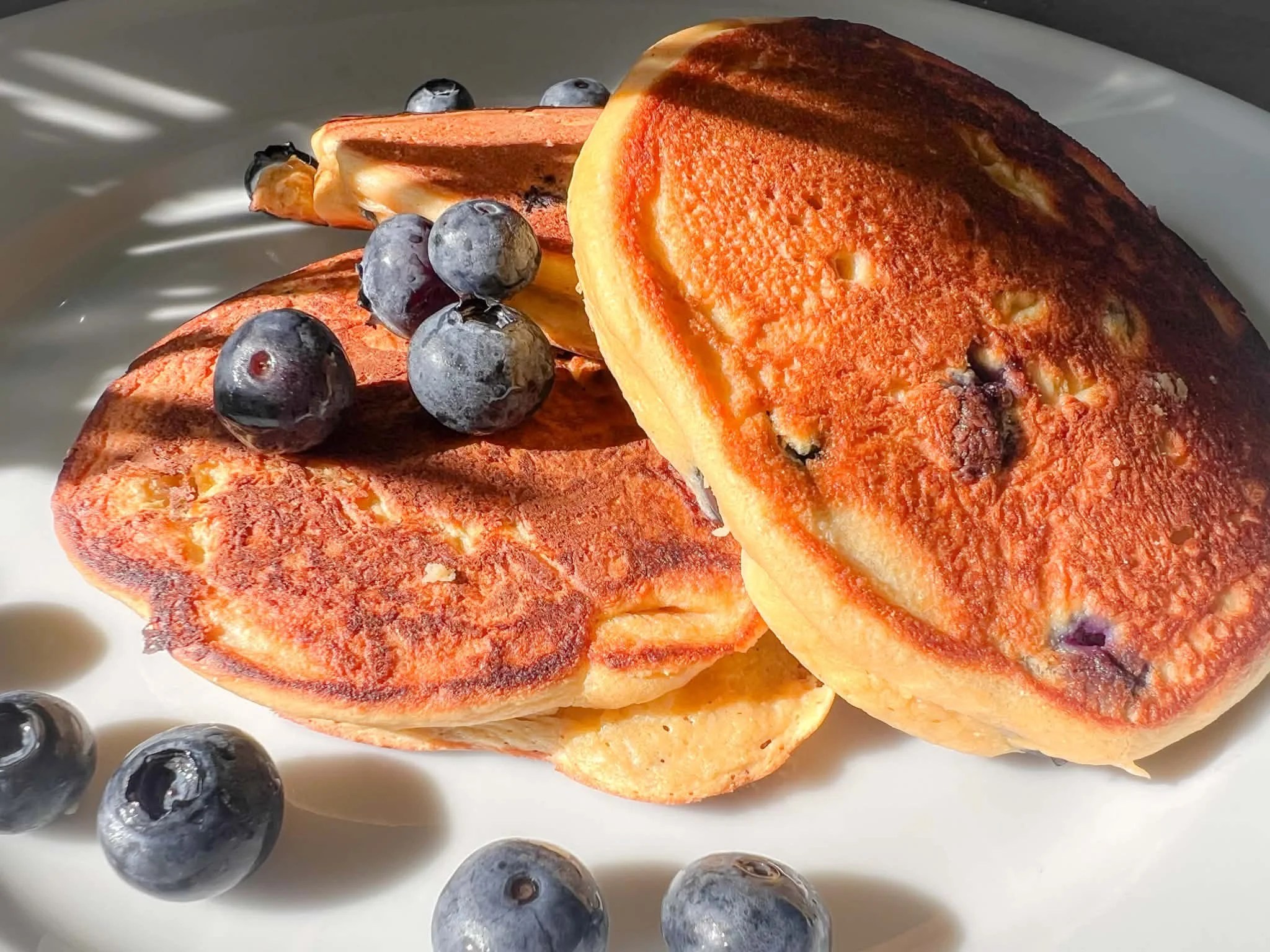
Blueberry pancakes served with fresh blueberries in morning sunlight.
Food can support our bodies and still be delicious. We can make intentional choices without turning every meal into a test of our discipline. We can learn what helps us feel energized, satisfied, and well without stripping away the foods, traditions, flavors, and experiences that make eating one of life's genuine pleasures.
And sometimes supporting ourselves means adding something rather than taking something away. More nourishment. More color. More fiber. More protein. More satisfaction. More attention to how a meal makes us feel afterward. There are so many ways to care for ourselves that don't begin with a list of everything we're no longer allowed to have.
That matters because restriction may create short-term compliance, but a way of eating that makes you miserable is going to have a very difficult time becoming a way of living.
I wanted Love Eat Crave Wellness to make room for both: caring about your health and enjoying the life you're caring for.
Because what is the point of building a healthier life if we're too busy policing it to actually enjoy living it?
Maybe the answer isn't to try harder. Maybe it's to understand ourselves better—to notice the patterns we've been repeating without realizing it, understand what happens when we're stressed, exhausted, overwhelmed, lonely, bored, or stretched too thin, and pay attention to what helps us feel well and what consistently gets in the way. Instead of trying to overhaul everything at once, we can begin making choices that actually make sense for the lives we're living.
That approach may not sound as exciting as a dramatic transformation promising an entirely new you in thirty days. But I've come to believe there is something far more powerful in learning how to care for the person you already are.
Because sustainable wellness isn't built in perfect conditions. It's built on ordinary Tuesdays. During busy seasons and disrupted routines. On vacations and holidays. When motivation is high and when it isn't. It has to be flexible enough to bend when life changes without making us believe we've failed every time it does.
Consistency doesn’t require perfection. It requires finding what you can realistically do again and again.
That's the “another way” I wish I had understood much earlier.
Not another set of rules telling me how much discipline I could prove I had. Not another attempt to force my body into submission. Not another version of wellness that worked beautifully until real life showed up.
A way built around awareness instead of judgment. Curiosity instead of criticism. Support instead of punishment. A way that recognizes nourishment, movement, sleep, stress, recovery, relationships, environment, pleasure, and purpose aren't separate pieces of a wellness checklist. They're parts of a life.
Your life—and your life will not look exactly like anyone else's.
That is why I don't believe there is one perfect way to “do” wellness. There are principles we can learn from, evidence we can use, skills we can build, and choices that can support our health. But those things still have to meet a human being on the other side.
There is a human being on the other side of all of it—someone with preferences and responsibilities, a history, a body, a family, a culture, a schedule, foods they love, things they're working through, and things they're working toward. Their life will change, which means their approach to wellness needs enough flexibility to change with it.
That is the kind of wellness I wanted to create space for when I built Love Eat Crave Wellness.
Not perfect wellness.
Not performative wellness.
Real wellness for real life.
For years, I thought I needed more willpower. More discipline. More control. I thought the answer was becoming better at forcing myself to do all the things I believed a healthy person was supposed to do.
Life taught me something very different. I didn't need to become better at fighting myself.
I needed another way.
